

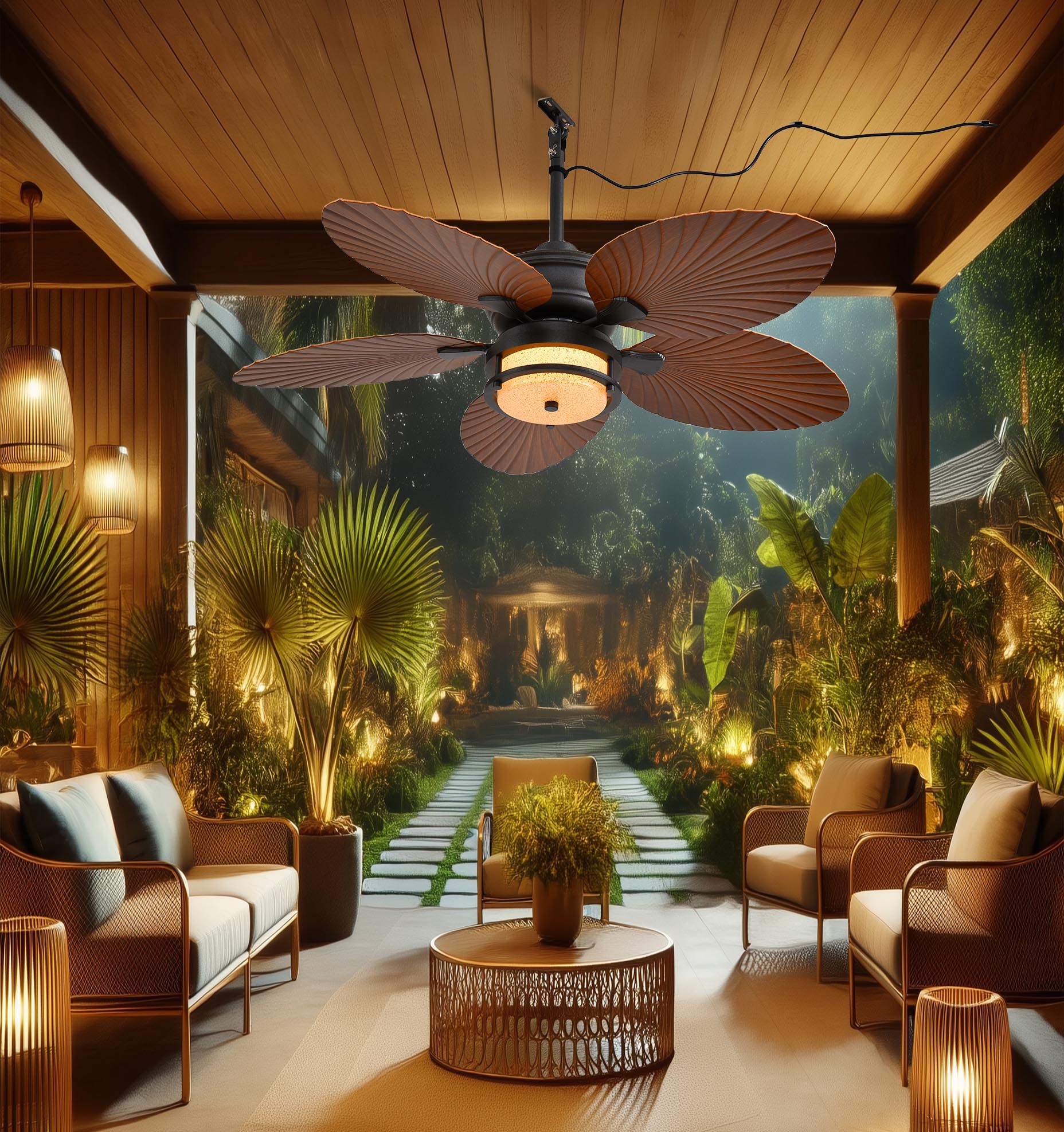
Opening: the comparative logic that matters
When you compare two products side by side, the differences show quickly — not just in price, but in durability, airflow, and real everyday use. This is why a focused comparison helps. For outdoor living, an outdoor ceiling fan with light must do more than spin; it must resist weather, move air efficiently, and integrate lighting smartly. We will look at performance, weather resilience, installation, and value. The goal: help you pick what really works on a covered patio or a small gazebo.

Why the box‑store choice so often disappoints
Box-store fans sell on looks and low price. But two problems show up fast: poor corrosion protection and weak motors. Many cheap models are not truly damp-rated; their bearings and motor mounts corrode in coastal salt air or humid summers. The result: wobble, noise, and shorter lifespan. Also, the lighting is often basic — dim, flickery, or not integrated for smart control. For a space you live in, that soon becomes annoying. You want steady CFM, quiet RPM range, and a light that actually reads as pleasant evening illumination.
How Orison’s design addresses real‑world needs
Orison focuses on a few things most box stores skip: sealed motor housings, marine-grade fasteners, and purposeful blade sweep. That means the fan keeps blades true longer and maintains rated CFM across seasons. Orison also integrates efficient LED lighting and compatibility with dimmers and smart controls — so you get comfortable light and airflow without rewiring the whole porch. The upshot: fewer callbacks, less maintenance, and a better-looking evening on the patio.
Performance comparison — what to test before you buy
When you shop, try to compare these measurable points:
- Airflow (CFM) at low, medium, high — real numbers beat vague “powerful” claims.
- Blade sweep and balance — larger sweep often means better room coverage.
- Motor sealing / IP or damp rating — important for coastal or high‑humidity climates.
Also check the light’s lumen output and color temperature; a fan with 1,500–3,000 lumens and tunable white is far more useful than a single warm LED. These are simple checks but many shoppers skip them because the box looks nice.

Installation and smart features — where Orison pulls ahead
Installation ease matters. Orison engineering tends to include modular mounting hardware and clear canopy adjustments for angled ceilings. Smart integration — supporting popular voice assistants or a dedicated remote with multiple zones — adds more real benefit than a lower sticker price. If you plan to retrofit an old junction box, look for a fan with a compatible mounting bracket and a motor hub sized for your existing drop. — You will thank yourself when the rewire doesn’t become a weekend project.
Durability, warranty, and real‑world anchor
Durability is where money shows its worth. In coastal Florida and along the Gulf Coast, homeowners report rapid rusting and motor failure on economy fans after just one summer of salt air exposure. By contrast, products with marine‑grade fasteners and sealed motors last multiple seasons with routine cleaning. NOAA’s reports on increased humidity and warmer summers underscore why choosing a damp-rated or wet-rated unit is no longer a niche concern but a common-sense decision for many regions. That real-world pattern is a strong anchor when evaluating longevity claims.
Alternatives and when a box‑store fan still makes sense
Not every situation needs premium hardware. If the ceiling is fully enclosed and you use the fan rarely, a basic model can be fine for cost-conscious buyers. For temporary outdoor covers or occasional use, the lower price may be justified. But for covered porches, pergolas, and gazebos where exposure and regular use are expected — consider stepping up. A middle ground exists: mid-tier models or local HVAC suppliers who sell better motors and balanced blade sets. Also explore an outdoor gazebo fan with light if you want a product explicitly tuned for smaller, enclosed outdoor rooms.
Common mistakes people make (and how to avoid them)
Buyers often skip three simple steps and regret it later:
- They ignore the damp/wet rating and then see premature corrosion.
- They don’t check motor noise and assume “silent” from pictures — testing RPM and bearing quality matters.
- They forget matching lumen output to space size — too dim or too harsh light spoils the mood.
One practical tip: always check first‑article specs and ask for measured CFM at each speed. That prevents surprises at install time. — It’s small effort up front, big savings later.
Head‑to‑head summary: core differences
Box‑store fans: low cost, decent looks, limited lifespan in humid or coastal environments. Simple light modules, cheap fasteners, and lower CFM on average. Orison fans: higher initial cost, engineered components (sealed motor, better blade sweep), integrated LED options, and smarter control compatibility. The difference shows in fewer service calls, steadier airflow, and a nicer evening light for guests.
Advisory close — three golden rules when choosing an outdoor fan
1) Verify the rating: choose damp- or wet-rated fixtures for true outdoor use. 2) Demand measured performance: ask for CFM figures at each speed and check blade sweep to match your space. 3) Match light to purpose: pick LED output and color temp that suit dining, reading, or ambient moods.
When these rules guide you, you pick a fan that lasts and performs — and that is where Orison often solves the practical gap between style and durability. —