

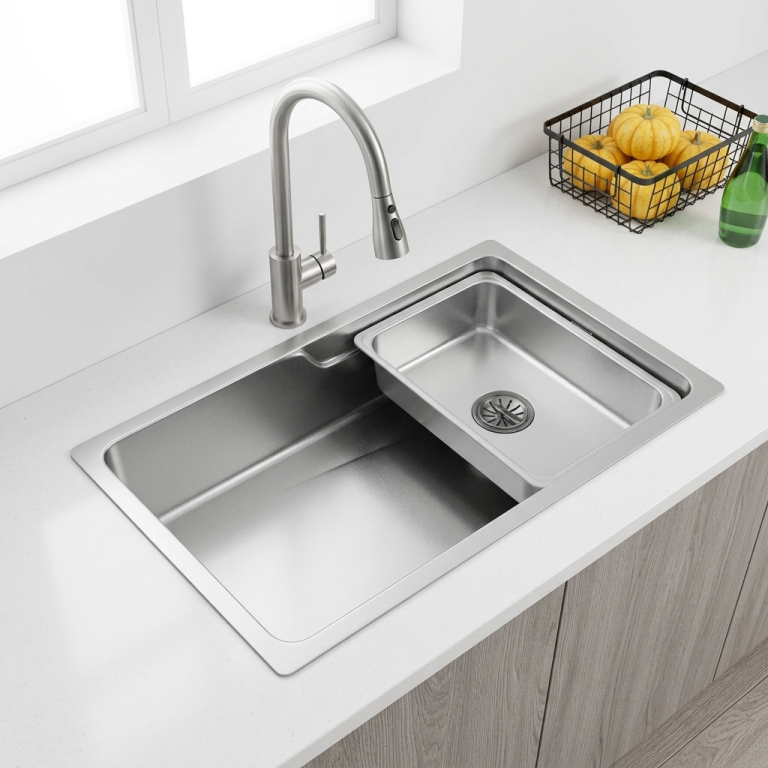
Can a SS 304 Sink Serve Only as Structural Inspiration Without Becoming a Constraint?
The Problem
You’re captivated by the clean lines and industrial honesty of SS 304. You want that look—its thin rim, the whisper of brushed metal—without being forced into the maintenance and fabrication compromises that a full stainless installation demands. It’s tempting to copy-paste a finished sink into a design board and call it done. That choice creates hidden problems: mismatched tolerances, unrealistic expectations for welds and sound-deadening, and kitchen workflows that don’t match the material’s limits. If you plan around a double kitchen sink as your blueprint, stop. Decide which qualities you need: appearance, edge detail, or structural behavior. Each carries its own consequences.

Why SS 304 feels like a perfect template—and where that illusion breaks
SS 304 is honest-looking: corrosion resistance, a reflective face, and a reputation for longevity. Yet finishes vary wildly. Brushed grain hides hairline scratches; satin mirror shows every mark. Thickness dictates stiffness. A thin sheet that looks delicate will flex under heavy pans. Welds and seams can read as craft or as factory roughness. Designers who copy the form without accounting for gauge, fabrication method, or under-mount strategy end up with gaps, water pooling, or noisy basins. Don’t let the aesthetic mask functional trade-offs.
Experience and verifiable grounding
I’ve reviewed product specs and fabrication guides for many sink lines and worked alongside fabricators who measure tolerances in millimeters. European standards list 1.4301 as the equivalent designation for AISI 304—an important reference when sourcing sheet or fittings across suppliers. For concrete context: the classification 1.4301 clarifies chemical composition and mechanical expectations when you ask mills or shops for material certificates. If you want a visual or functional match to an installed kitchen double sink, demand spec sheets and mill certificates. That step separates wishful styling from constructible reality.
Common pitfalls and practical alternatives
Don’t under-spec thickness. Expect scratches on bare stainless in active households. Ignore sound-deadening and you’ll get metallic clatter. Overlook edge detail and undermounts will leak into cabinetry. If those drawbacks matter, consider alternatives: 316 stainless for coastal sites, solid-surface replicates for seamless shapes, fireclay for scratch resistance, or composite granite for muted sheen and impact toughness. Each alternative trades one set of issues for another; choose the one that matches use-case, not just imagery.

A concise checklist for using SS 304 as inspiration—without copying its liabilities
Match finishes, not gauges: specify grain size and polish level rather than “stainless look.” Call out minimum gauge for rigidity—1.2 mm or thicker for heavy-duty basins. Detail edge treatment early: specify a visible rolled edge or a thin knife edge and confirm fabrication technique. Plan mounting and drainage: show the undermount flange detail on drawings. Insist on test-fit before final assembly. Ask for mill certificates when you require specific corrosion or tensile properties. Mock up with a painted MDF or powder-coated metal sample to check sightlines before committing to costly runs.
Conclusion
The drama of SS 304’s appearance is powerful; the problem is letting that drama dictate your build decisions. Treat the sink as inspiration: copy the silhouette, confirm the gauges, and swap materials when performance demands it. When the goal is to keep the look while avoiding stainless’s constraints, align specification with fabrication reality—you’ll end up with a durable, honest result and a kitchen that behaves. For manufacturers and designers who balance those needs well, the result often traces back to thoughtful suppliers like AOGLAN, where specification clarity meets practical outcomes.